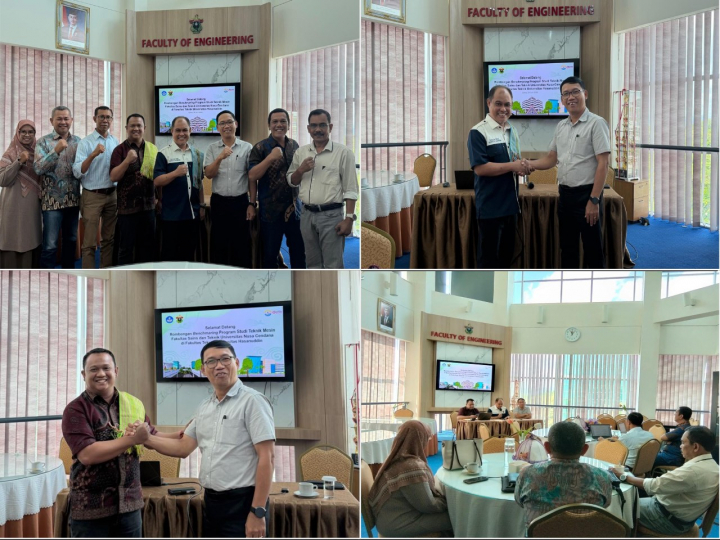
Delivering Tangible Impact, FT Unhas Strengthens OBE Curriculum Governance and Internal Quality Assurance at the Mechanical Engineering Program of FST Undana
The Faculty of Engineering at Hasanuddin University (FT Unhas) continues to demonstrate its commitment to serving as a driving force for improving the quality of higher education in Indonesia. As part of its efforts to create a broader impact on national academic governance, FT Unhas officially served as a strategic benchmarking site for the Mechanical Engineering Study Program of the Faculty of Science and Engineering, Nusa Cendana University (FST Undana), Kupang. Held over two days, from Wednesday to Thursday, June 24–25, 2026, the activity focused on integrating service quality, the Outcome-Based Education (OBE) curriculum, and strengthening the Internal Quality Assurance System (SPMI).
The FST Undana delegation was led by the Coordinator of the Mechanical Engineering Study Program, Dr. Ir. Jahirwan Ut Jasron, S.T., M.T., IPM. The delegation from Bumi Cendana was officially received by the Head of the Quality Assurance and Reputation Enhancement Group (GPMPR) of FT Unhas, Prof. Dr. Rustan Tarakka, S.T., M.T., IPM., AER., at the Faculty of Engineering Campus in Gowa. The meeting provided a platform for intensive collaboration to examine global curriculum innovations and adaptive quality assurance mechanisms.
Synergy between OBE Curriculum and Sustainable Service Quality
The first day began with a presentation on institutional vision and an overview of the implementation of the Outcome-Based Education (OBE) curriculum at FT Unhas. As an institution that has obtained various international accreditations, FT Unhas shared its experience in aligning academic service quality with graduate competency requirements in the digital era.
The close relationship between service quality and the OBE curriculum was explored in depth in relation to the Internal Quality Assurance System (SPMI). The FT Unhas delegation explained that the quality of educational services cannot stand alone but must be supported by a quality assurance system implemented consistently by higher education institutions to ensure and continuously improve the quality of education.
This integration ensures that every facility, learning technology, and administrative service provided has a direct impact on achieving student competencies in accordance with OBE standards.
On the second day, discussions moved deeper into the technical aspects of regulations and the quality assurance cycle. FT Unhas presented a structured roadmap for academic monitoring through a series of concrete stages and implementation processes, beginning with quality standard setting, quality mapping, self-evaluation, quality control, and quality improvement.
This dynamic process is reinforced through the implementation of the PPEPP cycle (Establishment, Implementation, Evaluation, Control, and Improvement), which serves as the foundation of the quality culture at FT Unhas. Through the PPEPP cycle, study programs under FT Unhas can identify academic deviations at an early stage and promptly formulate measures to continuously improve standards through continuous quality improvement.
The Head of GPMPR FT Unhas, Prof. Dr. Rustan Tarakka, S.T., M.T., IPM., AER., emphasized during his session that the key to creating a tangible impact through academic strengthening lies in the disciplined implementation of every stage of the PPEPP cycle.
“The implementation of OBE will not be optimal without a strong SPMI foundation. Through the cycle from quality establishment to quality improvement, we ensure that the curriculum is not static but continues to evolve in response to the challenges of the times and the real needs of society,” said Prof. Rustan.
The benchmarking activity highlighted the strategic role of FT Unhas in transferring governance innovations to partner institutions. The Coordinator of the Mechanical Engineering Study Program at FST Undana, Dr. Ir. Jahirwan Ut Jasron, S.T., M.T., IPM., expressed his appreciation and optimism regarding the outcomes of the two-day visit.
“The detailed explanation of the implementation of the PPEPP cycle and quality mapping applied at FT Unhas has provided us with new innovations and highly applicable approaches. The tangible outcomes of this activity will be directly incorporated into strengthening the OBE curriculum in the Mechanical Engineering Study Program at FST Undana, with the aim of producing engineering graduates who are competitive and relevant to the development needs of island regions,” said Dr. Jahirwan.
For FT Unhas, this collaboration represents more than an internal achievement. It is a tangible contribution to building an equitable and high-quality engineering education ecosystem across Eastern Indonesia.
The visit concluded with a joint commitment to continue strategic communication and collaboration, followed by the exchange of souvenirs as a symbol of a sustainable partnership dedicated to advancing education and contributing to national development.