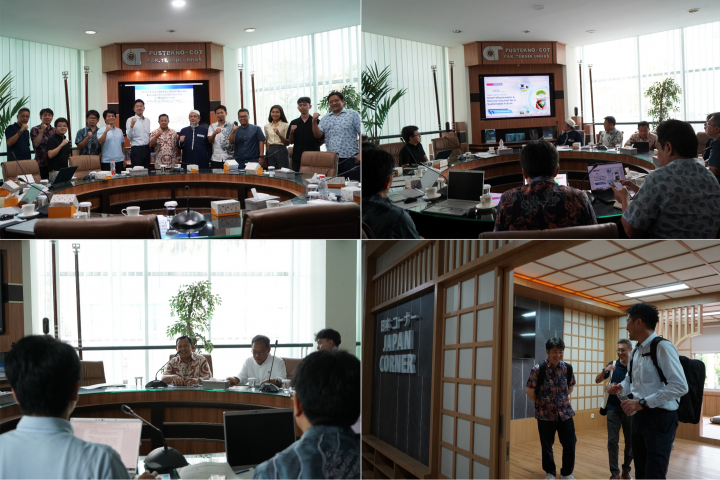
Advancing Decarbonization in the Water Infrastructure Sector, FT Unhas Partners with the Kawasaki City Consortium and Japanese Industry
The Faculty of Engineering at Hasanuddin University (FTUH) is advancing impactful academic solutions for sustainable development. On Tuesday, July 28, 2026, the Centre of Technology (CoT) FTUH at the Gowa Engineering Campus hosted a high-level delegation from Japan as part of an exploration of strategic cooperation under the City-to-City Collaboration Project between Kawasaki City and Makassar City for Decarbonization in the Water Infrastructure Sector.
The Japanese delegation was led by Hideaki NISHIMOTO, Director of Mikuniya Corporation, and included representatives from Kawasaki City, CTI Engineering International Co., Ltd., and PT Daiki Axis Indonesia. The delegation was officially welcomed by the Head of the Centre of Technology (CoT) FTUH, Dr.Eng. Faizal, S.T., M.Inf.Tech., M.Eng., accompanied by the Head of the Department of Civil Engineering, Prof. Dr. Ir. Muhammad Wihardi Tjaronge, S.T., M.Eng., and the Secretary of the Department of Civil Engineering, Dr.Eng. Ir. Bambang Bakri, S.T., M.T., IPU., AER.
Strengthening Historical Ties and the Strategic Role of CoT FTUH
In his opening remarks, Dr.Eng. Faizal expressed his appreciation for the visit by the Kawasaki City consortium and representatives of Japanese industry. He emphasized that the FTUH campus has longstanding historical and institutional ties with Japan through support from the Japan International Cooperation Agency (JICA) and the continuation of the C-Best Project.
“The Faculty of Engineering at Hasanuddin University is always pleased to welcome our partners from Japan because the FTUH campus was developed through cooperation with Japan through JICA and the C-Best Project. CoT serves as an interface between experts at FTUH and industry, including state-owned and private enterprises, as well as government institutions. We hope that further cooperation between Kawasaki City and CoT can be strengthened,” said Dr.Eng. Faizal.
Technology Innovation and Decarbonization-Based Business Opportunities
The head of the delegation, Hideaki NISHIMOTO of Mikuniya Corporation, explained that the consortium's primary focus is on energy efficiency and the decarbonization of water infrastructure and waste treatment. He also presented Japan's experience in managing the Free Nutritious Meals (MBG) scheme, in which food waste is processed into environmentally friendly compost.
“Japan also has an MBG program, and food waste from the program is processed into compost. Research of this kind has already been implemented in various locations. We are very interested in exploring how waste from companies and industries can be converted into energy, and we can discuss the potential business models. Our main focus is decarbonization,” said Hideaki NISHIMOTO.
In line with this focus, Jun ITO, Vice Director of PT Daiki Axis Indonesia, introduced decentralized wastewater treatment technology known as Johkasou. The systems are manufactured in Cikande, Serang, Banten, in accordance with Japanese quality standards and have been exported to various countries across Asia and Africa.
“Daiki Axis offers various regular Johkasou models designed for efficient industrial wastewater treatment in Indonesia. These models are equipped to handle high loads, ensuring rapid treatment processes with minimal maintenance. We also offer Domestic Johkasou models specifically designed for domestic wastewater treatment in Indonesia to address the need for effective wastewater management. Domestic wastewater originates from human activities such as cooking, bathing, washing, and handwashing,” explained Jun ITO.
Feasibility Study Roadmap, JCM Scheme, and Appointment of FTUH as an Advisor
The meeting continued with a technical presentation on the City-to-City Collaboration cooperation framework. MATSUNAGA Takahiro, a water-sector Professional Engineer from Kawasaki City, presented the findings of a field evaluation of water treatment facilities in Makassar. The annual water distribution at the Antang Water Treatment Plant (IPA Antang) was considered insufficiently stable and therefore less suitable as a Pilot Area, as the facility primarily serves a supporting function.
“We recommend the Panaikang Water Treatment Plant or Maccini Sombala Water Treatment Plant, which would be highly suitable because they are supplied by the Bili-Bili Dam. We will submit a proposal to the Makassar City Government, and therefore we would like to request assistance from Hasanuddin University as an advisor. A draft Letter of Agreement will be submitted shortly,” said MATSUNAGA Takahiro.
Based on the project planning documents, the Feasibility Study establishes decarbonization targets through 2029 to support Indonesia's commitment toward Carbon Neutrality by 2050. The project focuses on several key areas:
Greenhouse Gas Emission Reduction Study under the JCM (Joint Crediting Mechanism): Application of a Japanese sludge reduction system to reduce methane emissions from landfills and improve fossil fuel efficiency through support from the Japanese Government.
Operational Energy Efficiency at Water Treatment Plants: Optimization of pump operations based on water demand forecasting, combined with the utilization of solar panels and battery storage systems.
Non-JCM Studies: Reuse of treated sludge as compost through resource recovery, implementation of Johkasou sanitation systems, and reduction of water losses through Non-Revenue Water (NRW) reduction initiatives.
Policy Cooperation: Development of policy and institutional recommendations for decentralized wastewater treatment systems.
FTUH Response: Academic Solutions for Sustainable Cities
The Secretary of the Department of Civil Engineering at FTUH, Dr.Eng. Ir. Bambang Bakri, S.T., M.T., IPU., AER., affirmed FTUH's full readiness to support the research and policy implementation associated with the initiative.
“We can undertake joint projects and studies for Makassar City or Kawasaki City, drawing on the wide range of expertise available at FTUH. In general, Indonesian government institutions have greater confidence when initiatives are supported by universities. Makassar City has already prepared strong wastewater treatment infrastructure, and if there are examples of effective water and waste treatment technologies, these can first be introduced to the Makassar City Government. In addition, Makassar City has separated organic and non-organic waste as of August 2026,” said Dr.Eng. Bambang Bakri.
Through this international collaboration, the Faculty of Engineering at Hasanuddin University once again demonstrates its role as a pillar of innovation and applied research, delivering tangible contributions to community development, environmental sustainability, and the strengthening of its academic reputation on the global stage.