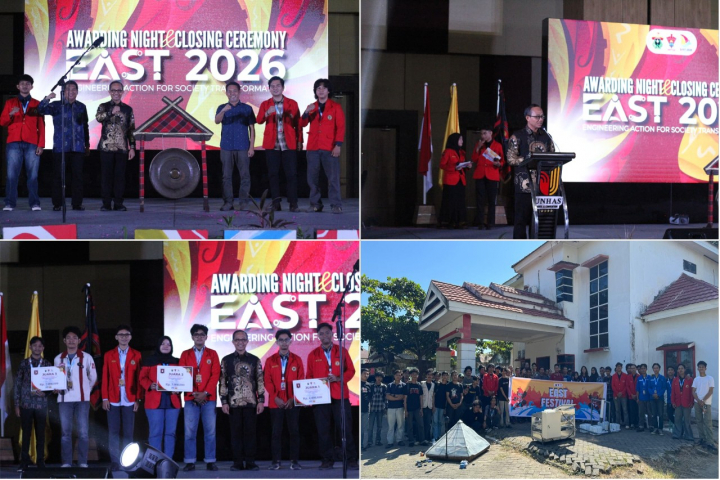
From Energy Transition to Student Leadership, EAST 2026 Strengthens the Engineering Innovation Ecosystem at Hasanuddin University
Makassar – The Faculty of Engineering at Hasanuddin University (UNHAS) has reaffirmed its commitment to preparing graduates who are adaptable to global challenges through the Engineering Action for Society Transformation (EAST) 2026. Under the theme “Integrated Green Engineering Solutions for Global Resilience,” the event provided a collaborative platform for students, academics, alumni, and practitioners to promote engineering innovations capable of addressing sustainable development challenges, particularly in the areas of energy transition and green infrastructure. The series of activities was held on July 5–6, 2026, at the UNHAS Hotel and Convention.
Unlike conventional scientific competitions, Engineering Action for Society Transformation (EAST) is an annual initiative organized by the Faculty of Engineering at Hasanuddin University as a platform for developing students' academic potential, creativity, and competitiveness in science and technology. EAST serves not only as a competition but also as a space for students to develop their potential by strengthening critical thinking, problem-solving, scientific communication, and cross-disciplinary collaboration in developing solutions to various societal challenges.
EAST 2026 featured two main competition categories: the Rural Engineering Innovation Design Challenge (REIDC) and the Green Energy Innovation Paper Challenge (GEIPC). Both competitions were designed to encourage students to develop practical engineering-based innovations that are relevant to national development needs and global challenges.
REIDC provided students with an opportunity to design appropriate technology innovations capable of delivering direct benefits to communities, particularly in coastal areas. The competition encouraged participants to identify real-world challenges in the field and develop engineering solutions that are practical, sustainable, and responsive to local community needs. Through this approach, students not only strengthened their technical capabilities but also developed greater social awareness and the ability to design technologies oriented toward community empowerment.
Meanwhile, GEIPC focused on developing scientific ideas and policy recommendations in the areas of energy transition and sustainable infrastructure development. Through GEIPC, participants were encouraged not only to produce innovative academic work but also to formulate solutions that can support low-carbon energy policies, accelerate the achievement of the Sustainable Development Goals (SDGs), and strengthen collaboration between young academics and stakeholders in the energy and infrastructure sectors.
This approach demonstrates that engineering innovation goes beyond technological development and can also contribute to public policymaking and national development.
The competitions addressed four strategic sub-themes: Sustainable Infrastructure and Climate-Responsive Urban Development, Green Maritime and Smart Port Systems, Sustainable Earth Resources and Low-Carbon Extraction Technology, and Smart Energy Systems and Digital-Based Energy Innovation. These four sub-themes represent real challenges facing Indonesia, ranging from responding to climate change and improving energy efficiency to developing green infrastructure and utilizing digital technologies to create smarter and more sustainable energy systems.
As part of the event series, EAST 2026 also featured a talk show titled “Integrated Green Engineering Solutions for Global Resilience,” with Nurwanti Aprilia Ningrum, S.T., an alumna of the Department of Electrical Engineering, Faculty of Engineering, Hasanuddin University, serving as the speaker.
In her presentation, she explained that the energy transition is not simply about replacing fossil fuels with renewable energy sources. Rather, it represents a comprehensive transformation of energy systems to make them more efficient, lower in emissions, more resilient to climate change, and capable of ensuring a sustainable energy supply for society.
Nurwanti emphasized that the success of the energy transition requires close collaboration among universities, industry, government, and communities. According to her, future engineering graduates must possess systems-thinking capabilities, technological expertise, and an understanding of social and environmental considerations in order to develop solutions that create genuine and measurable impact.
This perspective provided participants with new insights into the role of the modern engineer—not merely as a technology designer, but also as a problem solver capable of integrating innovation, sustainability, and societal needs. This is the essence of green engineering, an engineering approach that considers resource efficiency, carbon emission reduction, and environmental sustainability from the design stage through to technology implementation.
At the closing ceremony, Vice Rector for Academic and Student Affairs of Hasanuddin University, Prof. drg. Muhammad Ruslin, M.Kes., Ph.D., Sp.BM(K)., expressed his appreciation to the organizing committee and participants for the successful implementation of EAST 2026. He noted that the event demonstrated the increasingly professional organizational capabilities of student organizations while also serving as a strategic platform for fostering a culture of innovation and collaboration within the university.
Prof. Ruslin also encouraged EAST to continue developing into a national-scale competition involving more higher education institutions across Indonesia. According to him, expanding the network would enrich the exchange of ideas, accelerate the development of cross-disciplinary innovations, and further strengthen the reputation of the Faculty of Engineering at Hasanuddin University as a center for developing outstanding engineering talent.
Through EAST 2026, the Faculty of Engineering at Hasanuddin University once again reaffirmed that engineering education is not solely focused on mastering science and technology but also on the ability to develop innovative solutions that deliver tangible benefits to society.
The synergy among students, lecturers, alumni, practitioners, and university leadership is expected to foster a new generation of engineers who are integrity-driven, adaptable, and ready to become catalysts for transformation toward a greener, more resilient, and sustainable future.