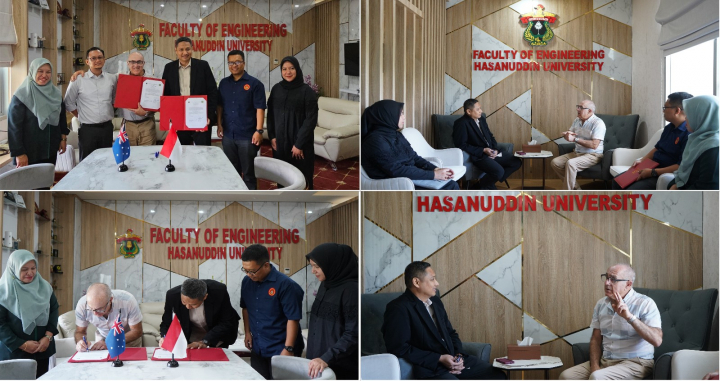
The Faculty of Engineering at Unhas and an Australian Waste Management Company Officially Agree to an Academic and Research Collaboration on Food Waste Management Through the Signing of a Letter of Intent
The Faculty of Engineering at Hasanuddin University (FT Unhas) has taken a new strategic step toward expanding its global partnership network and strengthening sustainable research. Held in the Dean’s Office of the Faculty of Engineering at Unhas in Gowa, a signing ceremony for an international cooperation agreement—specifically a Letter of Intent (LoI) for Academic Cooperation—took place between the Faculty of Engineering at Unhas and Wasteplant Company, a leading Australian environmental innovation firm, on Thursday (June 18, 2026).
During the signing ceremony for this important document, the Dean of the Unhas Faculty of Engineering, Prof. Dr. Eng. Ir. Muhammad Isran Ramli, S.T., M.T., IPM., AER., was officially represented by the Associate Dean for Partnerships, Research, Innovation, and Alumni, Prof. Muhammad Bachtiar Nappu, Ph.D. Meanwhile, Wasteplant Company was represented in person by Andrew Hayim de Vries, the Founder and creator of Wasteplant technology and the Subpod composting system.
The signing of this cooperation agreement took place on the sidelines of the Strategic Partnership Program series, which began with a guest lecture titled “Wasteplant for Food Waste Management” initiated by the Department of Environmental Engineering at the Unhas Faculty of Engineering. Through this written agreement, both parties are fully committed to dedicating their best efforts to developing an integrated academic program covering education, collaborative research, and community service to address the global issue of food waste management.
“The signing of this Letter of Intent marks an important milestone for the Faculty of Engineering at Hasanuddin University, particularly in implementing the pillars of Partnership, Research, and Innovation on a global scale. Food waste management using a purely circular and high-tech approach, such as that employed by Wasteplant Company, is a model of applied research that is greatly needed in Indonesia,” said Prof. Muhammad Bachtiar Nappu, Ph.D.
Furthermore, Prof. Muhammad Bachtiar Nappu explained that this collaboration aligns with Unhas’s internationalization roadmap, under which every partnership must have a direct impact on enhancing student capacity and the quality of faculty research. “We want to ensure that this collaboration does not remain merely on paper.” The partnership with Andrew and the Wasteplant Australia team will be realized through international internship programs, joint research on adapting technology to the tropical climate, and a pilot project for zero-waste urban farming on campus. We are ready to support the acceleration of this environmental innovation program."
Meanwhile, Wasteplant Company Founder Andrew Hayim de Vries expressed his pride and enthusiasm regarding the warm reception and institutional commitment demonstrated by the academic community at the Unhas Faculty of Engineering. For Wasteplant Company, the collaboration with Unhas is a crucial step toward expanding its positive environmental impact across Southeast Asia, particularly in Eastern Indonesia.
"Hasanuddin University has a strong research reputation and environmental engineering students who are highly critical and full of energy. At Wasteplant, we believe in the philosophy of ‘Feed the Soil, Feed the World.’ Through this Letter of Intent, we are committed to sharing our subsurface composting system (Subpod) technology and our biological waste management methodology to be studied, developed, and implemented in collaboration with the academic ecosystem at Unhas,” said Hayim de Vries
The signed academic cooperation document emphasizes the development of a long-term, mutually beneficial relationship (mutually beneficial association). This synergy also opens opportunities for FT Unhas researchers to collaborate with the global network established by Wasteplant Company in 25 countries through the Food Education and Ecological Design (F.E.E.D.) Foundation and the Institute of Composting Studies Australia (ICSA).
The ceremonial signing of the LoI was witnessed by the leadership of the Department of Environmental Engineering, senior faculty members, and student representatives. The event concluded with an exchange of official mementos symbolizing the start of international academic-industrial collaboration between Makassar, Indonesia, and Byron Bay, Australia.