The Department of Environmental Engineering at the Faculty of Engineering, University of Surabaya, Hosts an Expert on Organic Waste Management to Discuss Wasteplant Solutions for Food Waste Management
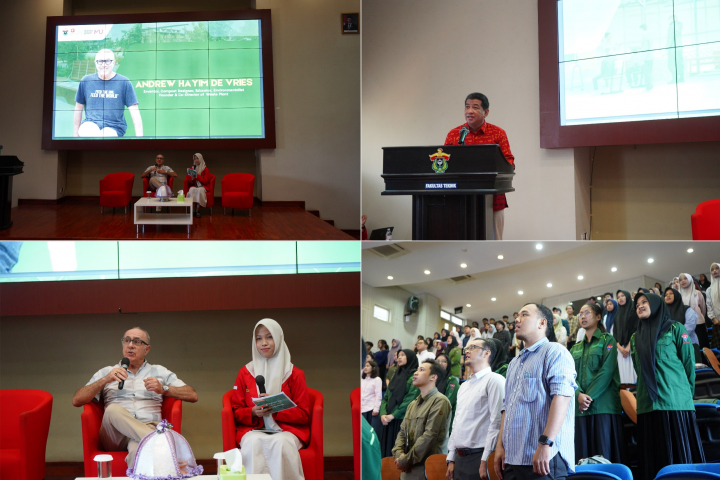
The Department of Environmental Engineering, Faculty of Engineering, Hasanuddin University (FT-UH), once again hosted an international-level academic forum through a Guest Lecture titled “WastePlant for Food Waste Management”, which took place on the 1st floor of the CSA Building, Faculty of Engineering, Unhas, Gowa Campus, on Thursday (June 18). The event featured Andrew Hayim de Vries—an inventor, ecological designer, educator, environmentalist, and founder and Co-Director of WastePlant Australia—as the keynote speaker.
This guest lecture was the result of a collaboration between the Department of Environmental Engineering at FT-UH and various partners, with the aim of enriching the knowledge of students, faculty, and researchers regarding organic waste management based on a sustainable approach capable of addressing both environmental challenges and global food security.
The event was officially opened by the Associate Dean for Academic and Student Affairs of the Unhas Faculty of Engineering, Dr.Eng. Hendra Pachri, ST., M.Eng., who was present on behalf of the Dean of the Unhas Faculty of Engineering. In his remarks, he emphasized that the chosen theme is highly relevant to the various global challenges currently facing the world’s population.
“The issues of food waste and the global food crisis are interrelated. On one hand, the world is facing an increase in the volume of organic waste that has not been optimally managed; on the other hand, many countries are also facing threats to food security due to climate change, environmental degradation, and population growth,” he explained.
Dr. Eng. Hendra explained that universities have a strategic responsibility to provide a space for scientific discussion capable of bridging the gap between scientific advancements and the real-world needs of society. Therefore, the presence of international practitioners and experts such as Andrew Hayim de Vries presents a valuable opportunity for the academic community of the Faculty of Engineering to gain new perspectives on innovative and sustainable organic waste management.
“This guest lecture provides an opportunity for students and faculty to learn firsthand from an international expert with extensive experience in developing organic waste management systems. We hope this event will broaden horizons, strengthen international academic networks, and inspire innovations in the environmental field that can be applied in Indonesia,” he added.
On this occasion, Dr.Eng. Hendra also expressed his appreciation to the speaker for his willingness to share his experience and knowledge with the academic community of the Faculty of Engineering at Hasanuddin University.
“We extend our deepest thanks and highest appreciation to Andrew Hayim de Vries for taking the time to attend and share his experience. May academic collaborations like this continue and provide broader benefits for the advancement of science and sustainable environmental solutions,” he said.
In his presentation, Andrew Hayim de Vries explained the concept of Wasteplant, a food waste management system that integrates modern composting processes with sustainable food production. According to him, food waste should not be viewed as trash, but rather as a resource that holds ecological and economic value when managed properly.
Andrew is a figure who has spent more than four decades working in the fields of ecological design, organic waste management, urban farming, and the development of integrated composting systems. His experience spans various environmental projects in Australia and several other countries focused on transforming organic waste into productive resources.
During his guest lecture, he explained that the Wasteplant system is designed to convert food waste into healthy growing media and soil through an efficient biological process. This approach not only reduces the volume of waste ending up in landfills but also contributes to improved soil quality, carbon sequestration, and local food production.
“Food waste is actually a very valuable source of nutrients. When organic waste is returned to the soil through the proper process, we not only reduce waste problems but also build a healthier and more sustainable food system,” explained Andrew.
He emphasized the importance of a paradigm shift from the linear “take–use–dispose” model toward a circular model that allows resources to be continuously reused. According to him, universities play a crucial role as innovation laboratories for developing science- and technology-based waste management solutions.
In addition to presenting WastePlant’s technological innovations, Andrew Hayim de Vries specifically highlighted his commitment to building strategic partnerships with leading higher education institutions in Indonesia. Currently, WastePlant is engaging in close collaboration and research synergy with several major universities across the country, including Hasanuddin University (Unhas) in Makassar, the Sepuluh Nopember Institute of Technology (ITS) in Surabaya, Udayana University (Unud) in Bali, and Mataram University (Unram) in Lombok. This cross-university collaboration focuses on testing and adapting the “Subpod” subsurface composting technology for tropical regions, developing a community-based organic waste management curriculum, and implementing sustainable applied research involving students and faculty to support the achievement of the Sustainable Development Goals (SDGs) in Indonesia.
The guest lecture was conducted interactively and attended by students, faculty members, and researchers from various academic programs within the Unhas Faculty of Engineering. Participants appeared enthusiastic about the presentation, which included various case studies and experiences implementing WastePlant in different locations.
The discussion session was one of the parts that most captured the participants’ attention. Various questions were raised regarding the potential for applying the WastePlant concept in Indonesia, campus-scale organic waste management, integration with food security programs, and opportunities for developing similar technologies in urban areas.
Participants also gained insight into the importance of multidisciplinary collaboration in addressing environmental issues. This collaboration involves not only the technical aspects of waste management but also encompasses changes in public behavior, public policy, environmental education, and the development of a circular economy.
This guest lecture is part of the Faculty of Engineering at Hasanuddin University’s commitment to strengthening the internationalization of education while supporting the achievement of the Sustainable Development Goals (SDGs), particularly in the areas of environmental management, responsible consumption and production, and food security.
Through academic activities such as this, the Faculty of Engineering at Hasanuddin University continues to foster a learning ecosystem that is adaptable to global developments and capable of producing graduates with an international perspective and a strong commitment to sustainability issues.
The guest lecture “WastePlant for Food Waste Management” is expected to serve as a catalyst for broadening understanding of the importance of food waste management as part of the solution to environmental challenges and the global food crisis. Furthermore, this event also opens opportunities for further collaboration between Hasanuddin University and international practitioners and institutions in the development of sustainable waste management technologies and innovations.